
Webster Previous Residents by Era
The backward trail for a Town of Webster address has several time layers. Start with a current parcel report and recorded-document reference, then choose the source that fits the date in question. County deeds establish a property sequence; historic street guides, census records, newspapers, and Museum collections test the household connection between transfers. No one layer proves uninterrupted occupancy, especially when a directory or map skips years.
| Source | Years it covers | Where held | What it shows |
|---|---|---|---|
| Monroe County deed ledgers | 1821 to present county history; older predecessor-county work before 1821 | County Clerk and County Historian route | Grantor and grantee trail, legal descriptions, recording references |
| Clerk online deed database | Index from Aug. 28, 1973; deed images from Jan. 2, 1976 | SearchIQS, public terminal, or document request | Free index data; images through the documented access options |
| Webster suburban directories | 1938, 1939, and 1940 verified digitized files | Rochester Suburban Directories | Address, householder, business, and street-layout snapshot |
| Central Library directory collection | Rochester directories from 1827; suburban collection from 1930 | Local History and Genealogy Division | Additional directory volumes and regional research context |
| Webster Museum materials | 1855 census copy; assessment records from the 1860s to 1930s; 1942 survey | Webster Museum and Historian | Address-sorted home and business files, street and name survey, maps |
| Sanborn and federal census material | Webster Sanborn years 1906, 1912, 1924; 1950 is the newest released federal census | Central Library resources and library census access | Building footprint context and dated household snapshot |
| Permit archive | No public online date span verified | Webster Building Department or a defined FOIL request | Dated work, project, certificate, or inspection evidence |
For a recent deed question, start with the parcel report and Clerk reference. For an older household question, insert the nearest directory, census, newspaper, or Museum date between the deed events. The result is a timeline of documented points, not a claim that every gap has been resolved.
Webster Previous Residents and Deed Access
The Monroe County Real Property Portal is the local starting point for an address. It displays property and sale context that can include a Book/Page bridge, but the public portal does not offer an owner-name search. The Town Assessment Office directs ownership questions to other channels and offers a public computer for people who need assistance with the assessment path. Copy the municipality, parcel ID, situs, sale date, Book/Page, and prior-owner field if it appears, then compare those details to the recorded instrument.
On April 1, 2026, the Clerk kept index information, including party names and property address, free to search while moving digital original documents behind a subscription. The distinction matters for previous residents research. The Clerk’s public terminals display images at no cost, and the online request form allows an identified land, court, or other document to be requested. The counter, terminal, request form, grantor/grantee ledgers, and microfilm are all real access channels.
The County Historian’s house-history guide sets out the local deed method used after the parcel handoff.
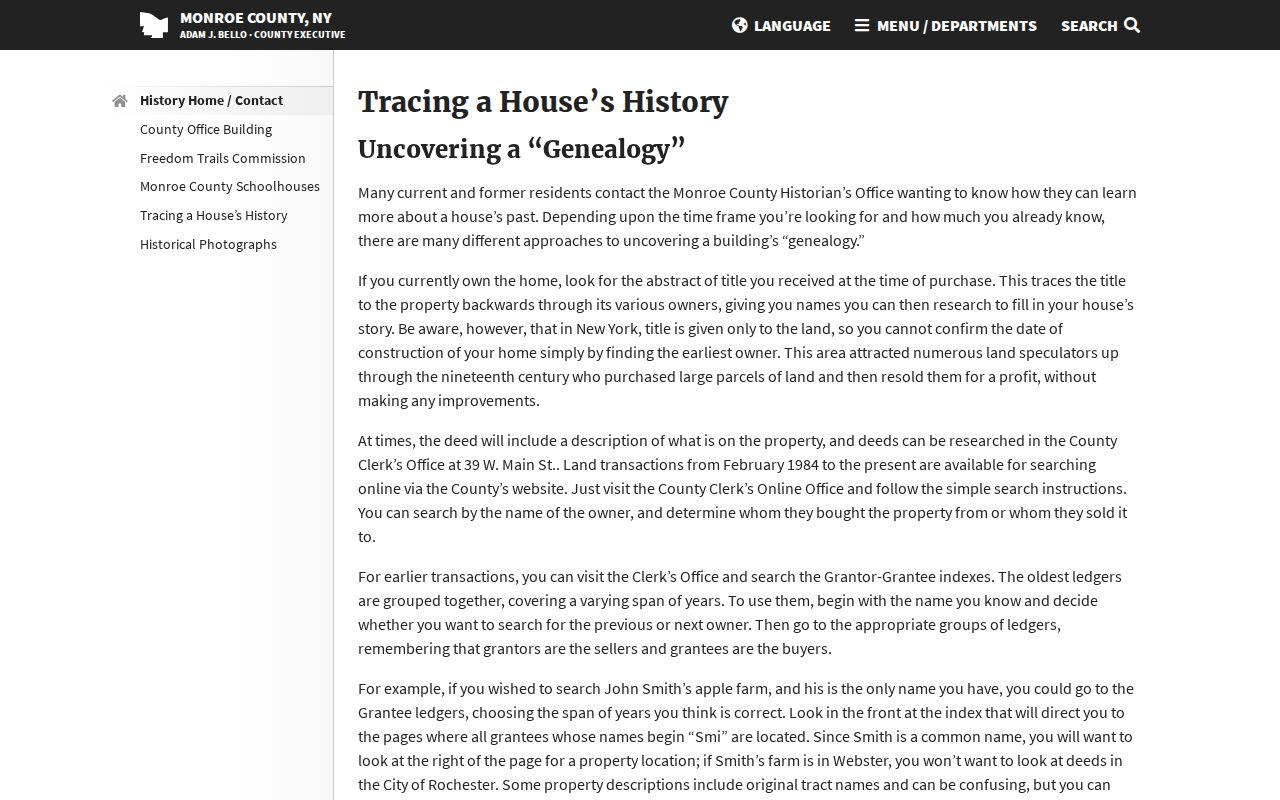
The guide is useful because it treats Book/Page, legal description, and municipality as checks on a deed chain. It does not assume a familiar surname or a shared street name identifies the same property.
Trace Webster Previous Residents in Deeds
The County Historian’s documented method follows a chain of title, not a string of address hits. Use the current property information to find the last recorded reference. In that instrument, compare the property description with the parcel context and identify the seller. Then use the grantee ledger to find how that seller acquired the same described property. Each move backward must retain the municipality and legal-description comparison, because Monroe County records include Rochester and town properties in the same broad record environment.
- Search the current Town of Webster site address in the property portal and record the municipality, parcel ID, sales date, Book/Page, and prior-owner field where shown.
- Take Book/Page to SearchIQS or the Clerk counter, then compare the instrument parties, recording date, municipality, and legal description.
- Identify the seller or prior owner from the transfer and look for that person as a grantee in an earlier acquisition of the matching property.
- Repeat the buyer-to-earlier-seller step while retaining spelling variants and comparing the legal description rather than relying only on the street number.
- When the online era ends, continue with Clerk ledgers or microfilm. For land before Monroe County’s 1821 creation, ask about Ontario and Genesee County microfilm.
- Grantor
- The party conveying an interest in a recorded instrument.
- Grantee
- The party receiving that interest; the grantee index helps locate an earlier acquisition.
- Chain of title
- The documented sequence of recorded transfers for the same described land.
- Legal description
- The deed’s land-identifying language, which can remain useful when street names or numbers change.
Monroe Grantee Ledgers for Webster
Monroe County formed in 1821, which is the key boundary for a long property history. The County Historian says older grantor and grantee books and microfilm carry the local chain back to that creation date. Transactions before then can fall in Ontario or Genesee County material. The County Clerk also maintains naturalization records from 1821 to the present, but those are a separate record series and should not be substituted for a property trail.
The Monroe County Historian is in the Rundel building and gives its research hours as Monday 10 to 1, Tuesday 1 to 4, and Wednesday through Saturday by appointment, with Saturday closures in July and August. The County Archives are being processed, rehoused, and catalogued, so an online finding aid can grow over time. Ask for the relevant address, municipality, and date range instead of assuming every original record has been digitized.
The County Historian and archives page identifies this archival research route for Town of Webster address history.
This counter and appointment route is especially important when a historic record stops at a ledger, microfilm, or processing-stage archival description instead of opening as an online image.
Webster Maps Behind an Address
Maps can establish how a place looked or was labeled at a date, but not who lived there. Rochester Public Library’s house-history guide identifies Webster Sanborn coverage for 1906, 1912, and 1924 on CD-ROM. It also notes local plat-map years 1872, 1902, 1924, 1931, and 1941. The Webster Museum adds local maps from 1852, 1872, 1887, 1902, and 1912. Pair a map date with the deed’s legal description, a parcel identity, or a dated directory entry before treating it as evidence about a particular address.
Historic imagery in Town GIS adds another time layer, with documented choices from 1930 through 2023. The viewer is not survey-grade, and an image of a building cannot identify a household. Used carefully, maps help explain why a road, lot boundary, or building description differs between deed years.
Old Webster Names and Addresses
An address can change even when the parcel does not. The Town’s Official Address Notifications describe a Sept. 16, 2025 correction after inconsistent use of a private road name and an unapproved name. The Town reassigned the official address and notified the post office, utilities, emergency services, and government agencies. Its notice also says older deeds and abstracts may retain the previous address.
When who lived here before seems to lead to a dead end, search the old and new address forms, then compare the PrintKey, parcel ID, tax-map context, legal description, and Book/Page. The individual notice date is the safer reference where a page-wide “current through” statement conflicts with later rows. This local continuity check is stronger than guessing from a similar road name.
Webster Previous Residents in Household Records
Property transfers are only one side of the past-residents question. The 1938 to 1940 Webster street guides place householders and businesses at numerical addresses, while the alphabetical directory section can provide occupation, business, or post-office information for people over 20 when a volume supplies it. The 1940 guide warns that the canvasser information is not guaranteed, marks incorrectly numbered streets with an asterisk, and defines its owner symbol as a householder or family-member owner mark rather than title proof.
- Locate the house number in the street guide and record the householder, nearby numbers, street routing text, and any symbols.
- Check the same name in the alphabetical portion for the details supplied by that specific volume.
- Compare the next available 1938, 1939, or 1940 directory file, then consult additional Central Library suburban volumes where available.
- Pair a directory date with the nearest released federal census. The 1950 census is the newest public federal snapshot as of 2026.
- Use a newspaper notice, cemetery resource, historical vital index, or Surrogate’s Court probate file to test later family or estate references.
The full collection shelf belongs on the Town of Webster City Directory page. Here, a directory year is used as one dated checkpoint between deeds. A directory gap does not show vacancy, and a name’s disappearance can reflect a move, a death, a different listing practice, or a missing volume.
Lawful use. Town of Webster house-history research is suited to family history, property history, civic curiosity, and checking a record with its custodian. Do not use it to track, threaten, stalk, or harass a living person.
Webster Museum Survey for Past Residents
The Webster Museum and Historian holds a distinctly local alternative when the directory run is thin: home and business records sorted by address, early assessment records across years from the 1860s to the 1930s, a copy of the 1855 Webster census, and a 1942 resident survey arranged by street and name. It also identifies family genealogies, diaries, yearbooks, school ledgers, bound Webster Herald volumes, and historic maps. Ask for a particular address, street, or year and clarify whether the requested material is from the Village, Town, rural-route, or historic-road context.
The Museum Historian collections page describes the address files and 1942 street-and-name survey.
These Museum holdings can narrow a historical question to a documented time and place. They still need to be read with deed, map, directory, or census dates rather than converted into an unbroken address roster.
Webster Herald and Probate Endpoints
The Webster Library genealogy and local-history collection gives the Webster Herald a dated access path: digitized 1938 through 2021, microfilm 1938 through 2017, and physical copies from 2022 forward. Its yearbooks are digital for 1920 through 1988 in the library and physical from 1920 forward. Rochester Public Library’s Life Records index adds paid death notices from 1960 to 2016, birth notices from 1977 through Oct. 10, 2014, and marriage notices from 1965 through 2009, with article-copy requests.
Newspaper and notice indexes are leads, not vital certificates. When a death or relationship trail matters, seek a specific probate file through the Surrogate’s Court route or the relevant vital-record custodian, and note whether a document establishes a relationship or merely mentions a name. For historical genealogy copies, New York Department of Health rules set separate age and proof conditions for birth, death, and marriage records.
Webster Previous Resident Limits
A prior owner, a directory householder, and a person mentioned in a newspaper are not interchangeable labels. The public County parcel layer omits owner and mailing fields, and a final assessment-roll mailing field is correspondence information rather than proof of physical presence. New York’s Address Confidentiality Program, protected voter registrations, sealed records, and other privacy limits remain in force. Record each source date and state plainly what it proves.
Note: No located record is not evidence that a person was absent or that an address was vacant during the missing period.