
Finding Town of Webster Residents
No single public roll lists every person at every address in Webster. So begin with a fact you can test. An address is the strongest opening for a property question. The county record behind it can yield a tax-map parcel identifier plus a sale reference. Someone checking their own registration should use the state voter tool instead. A dated household question may belong at the library or Museum. It does not fit a current record. And remember: a deed records a transfer. It is not a census of everyone under one roof.
The first fact may be a Webster street address. Or it may be a name tied to a property. Follow a set order. Write down dates, parcel identifiers, and book and page references. Also note the source used at each step. A later result may correct an earlier spelling or street label. Hold on to the trail. For an older household, the historical sources come later. Move to them only after the property side has pinned down the location.
- Search the Monroe County Real Property Portal by address to identify the parcel, its physical situs, and any sale book/page lead.
- Use New York VoterLookUp only to check a registered voter’s own election information.
- Take a recorded-document reference to the Monroe County Clerk’s SearchIQS index or the Clerk counter.
- For a past household, compare the digitized directories and the local-history collections with the address and year in hand.
- Request a defined existing municipal file through the Town of Webster FOIL channel when a portal does not hold the needed record.
Note: A missing result does not prove that a person never lived in Webster or that a home stood empty.
Town of Webster Records Offices
Resident research in Webster is spread across Town, county, and state custodians. The property portal and the Town Assessment Office handle the parcel side of any address. The Monroe County Clerk holds recorded land instruments. The Clerk takes over once a book and page lead surfaces. Election records sit with the Board of Elections, and New York law limits their use. None of these offices is a combined list of residents. For a street-by-street property trail, use the Webster Streets directory.
Monroe County Clerk
39 W. Main Street, Room 101
Rochester, NY 14614
585-753-1600
Recorded land, court, and document-request access
Webster Assessment Office
1000 Ridge Road
Webster, NY 14580
585-872-7051
Local assessment-roll and parcel assistance
Monroe County Board of Elections
435 Smith Street
Rochester, NY 14608
585-753-1550
Election-record contact and access conditions
The Town Clerk is another doorway worth knowing. It fulfills Town FOIL requests and can steer a requester toward a specific existing record. The Building Department offers a separate address-based path through identified permit and certificate files. It provides no online permit search by address.
Webster Residents by Property Address
With an address in hand, the public county portal is the most practical first stop. Town instructions say to type the address without its street, lane, or road suffix. Pick the assisted dropdown result and select Search. A parcel result can then display the municipality or SWIS code, parcel ID, situs address, assessed values, property class, school district, lot details, building characteristics, roll year, and a sales-history reference. That is a lot of evidence. It still describes a property rather than the people connected to it.
| Portal field | How it helps a Webster search | Boundary |
|---|---|---|
| Address | Starts the Town-documented property route without a suffix. | It identifies a parcel location, not a household. |
| Parcel ID / tax-map identifier | Preserves the property reference across map and assessment work. | The research did not verify a public parcel-ID input label. |
| Sales history and Book/Page | Creates a bridge to a recorded document at the County Clerk. | A sale entry is not a current-occupancy claim. |
| Map link | Connects the result to Monroe GIS for parcel geography. | Map displays are not survey-grade proof. |
The Monroe County property portal is the address-to-parcel starting point for Town of Webster residents directory research.
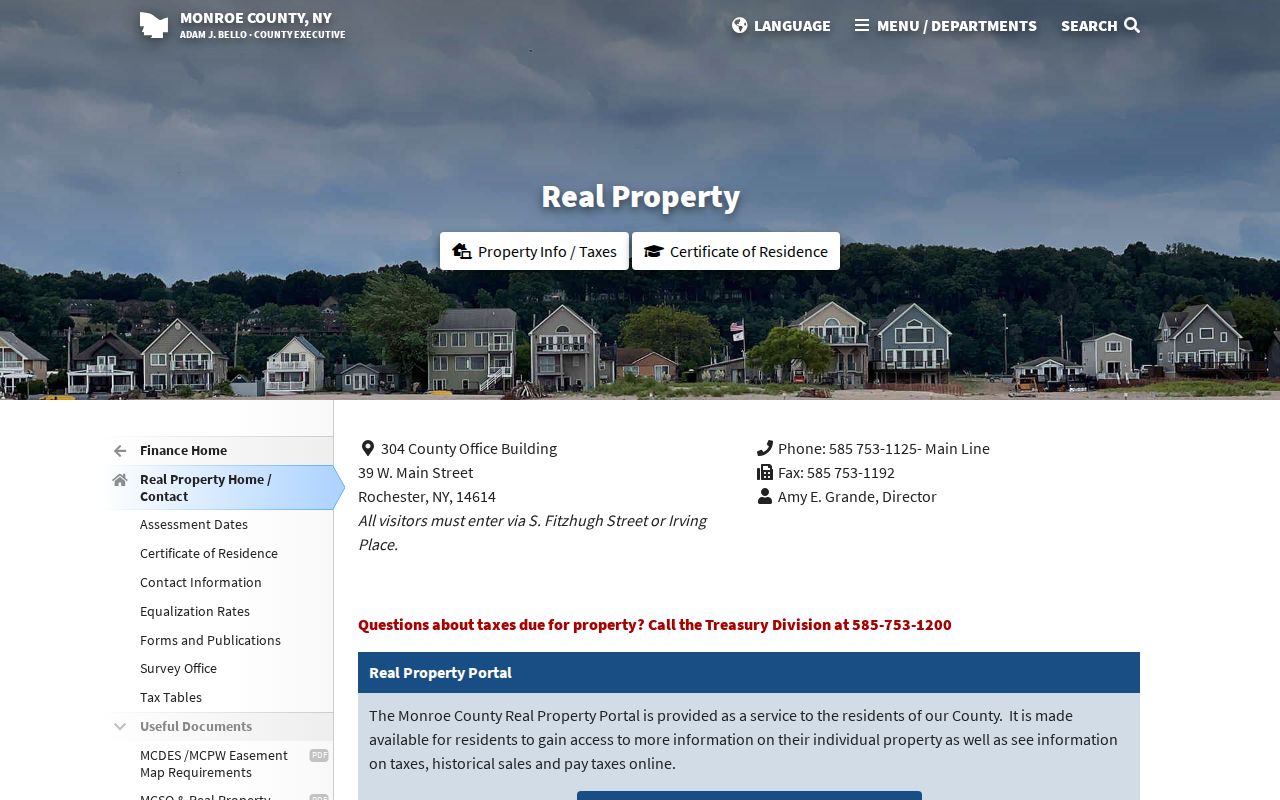
Keep the parcel ID and the recorded-sale reference together. Treat that pair as the stable handle on the property. It holds up far better than a street number alone when an address has changed or a common surname appears in more than one county record.
Current Town of Webster Directories
Current Webster resident sources are fragmented by design. Each one reflects a separate public function: taxation, land recording, voter self-service, staff contacts, or a community organization's own contact list. Ask what a given record can actually support. The county property screen describes a parcel but shows no owner names in its public interface. A recorded instrument names only the parties to a transaction. The staff directory covers Town staff and no one else.
| Webster source | What it can establish | Custodian | Access |
|---|---|---|---|
| Parcel and tax report | Situs, class, assessment facts, parcel ID, sale reference | Monroe County RPTS / Town Assessment | Public property portal and Assessment help |
| Recorded land index | Parties, document type, legal description, recording reference | Monroe County Clerk | Free index, terminal, request, or subscription image route |
| VoterLookUp | A registered voter’s own registration and poll information | New York State Board of Elections | Self-service identity inputs |
| Town staff directory | Public employee and department contact information | Town of Webster | Public directory search |
| Community organization inventory | Public organization contacts and activities | Town of Webster | Organization-level information, not member rosters |
For a one-person verification trail, compare matching record types and date ranges. Keep each piece of evidence separate. Do not fold a parcel location, a mailing field, and a dated directory entry into a single claim about a present household.
Webster VoterLookUp Is Personal
New York's VoterLookUp is a registered voter's self-service tool. It is not a public browse-by-street directory. The displayed form asks for County, last name, first name, date of birth, and ZIP code. Monroe is the county selection for a Webster voter. Results cover the voter's own registration, polling place, and mail-ballot information. The state requires JavaScript and cookies for the form to work.
The distinction matters. Election Law § 3-103(5) limits use of statewide voter-registration data to an election purpose. County election offices also carry separate statutory public-inspection duties around general-election lists. Those duties are subject to protected registrations. Neither rule turns the form into a general list of Webster residents. The New York VoterLookUp form shows the identity-checked entry point.
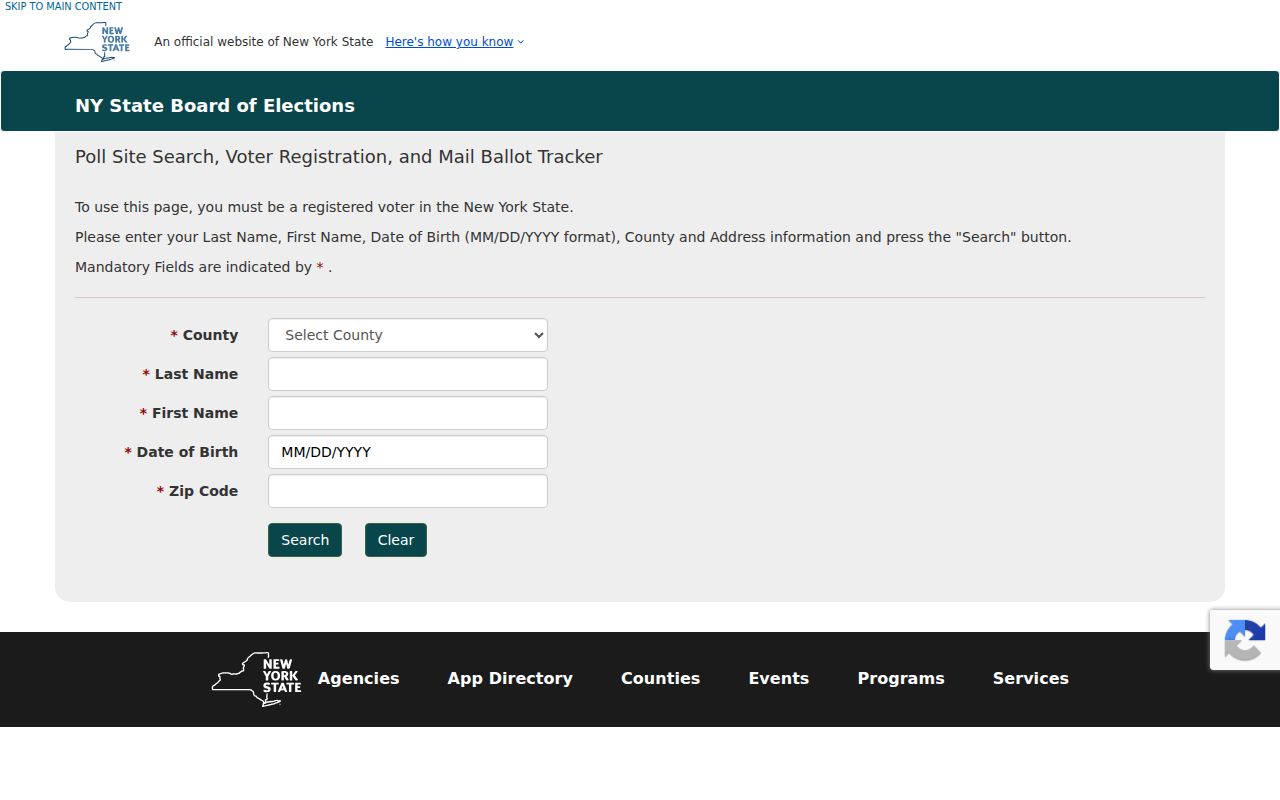
Use a result to confirm the voter's own election information only. For a lawful election-record question, contact the Monroe County Board of Elections and ask about the record type and its access conditions. Note: A voter status is an election-administration field, not a permanent statement of where someone lives.
Webster Clerk Index Access Changes
Recorded property records anchor a Webster residents directory, and a property report can yield a Book/Page reference worth chasing. SearchIQS posts a free index for party names, property addresses, and standard data. Monroe County changed policy on April 1, 2026. Digital originals became subscription-only. Clerk public terminals still show images free of charge.
The provider's availability table reports deed indexing from August 28, 1973 and images from January 2, 1976. The Clerk says many 1970s-to-present records are online. Older research still has channels. Grantor/grantee books, microfilm, the Clerk counter, and the County Historian carry the pre-digital trail. The policy change also launched free Fraud Alert registrations. Register a name or a property. An alert flags an accepted filing, not proof of an improper record.
The Monroe County Clerk document-request form offers an alternate copy channel after a free index search.
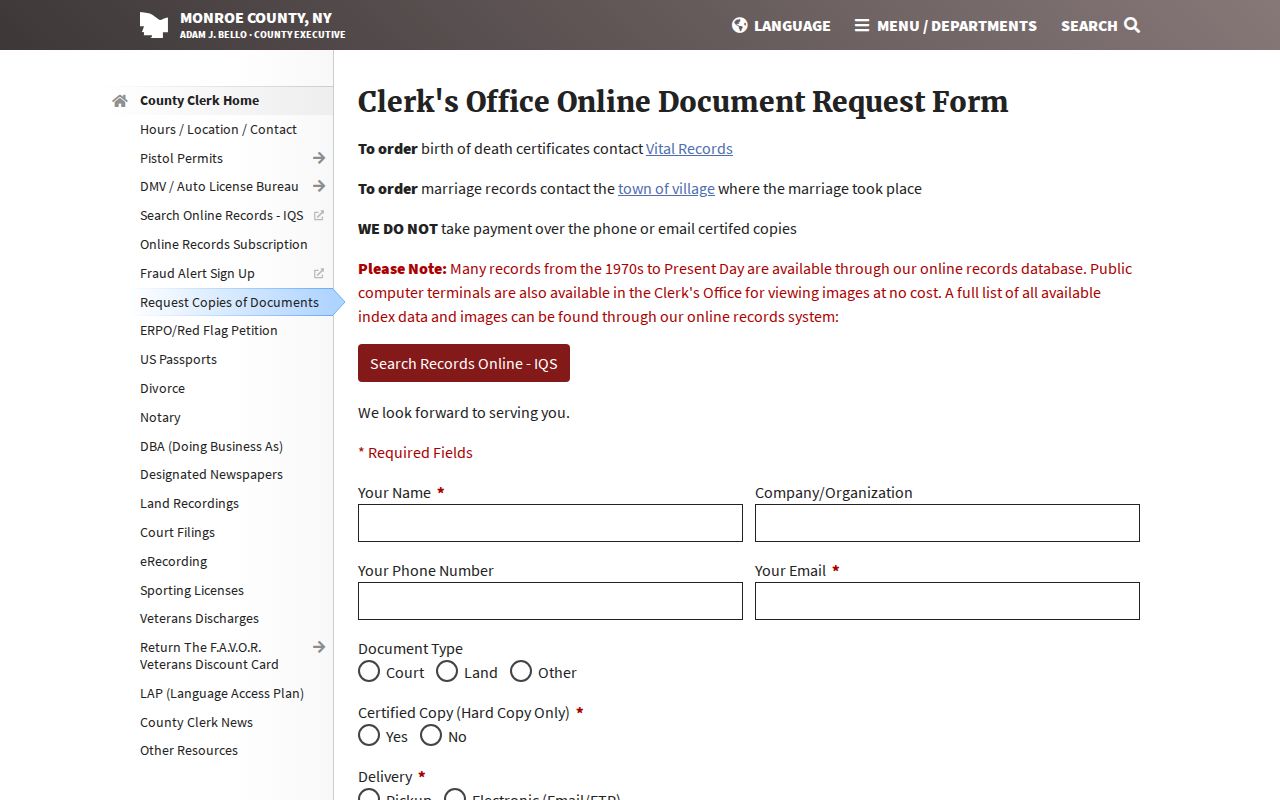
The request screen wants a document type. It also accepts a property address, names, Book, Page, or tax ID. Electronic delivery or pickup makes it a practical fallback once an index hit needs a copy.
Town of Webster Court Records
Court material can verify a defined case, but it is not a shortcut to a resident profile. Webster Town Court serves ZIP 14580 in the Seventh Judicial District. State eCourts offers current and disposed case information through separate tools for different case types, while NYSCEF guest search covers eligible e-filed Supreme Court material. A result may identify a case number, parties, court, status, or appearances. It does not mean that every file or document is public online.
Sealed matters, adoptions, youthful-offender matters, and other protected cases may be absent or unavailable. When a permitted record needs a copy, the court clerk or County Clerk is the controlling channel. Compare the case number, court, date, and party role before treating a name hit as the right person. The official Webster Town Court page supplies the local court contact point.
Court files answer narrow questions about a case. For the full record or a certified copy, ask the right clerk when the access rules permit it.
Town of Webster FOIL Requests
New York FOIL covers existing agency records. The law sits under Public Officers Law article 6, sections 84 through 90. It does not force a Town or county office to compile a fresh list of people. Nor must it answer an open-ended research question. The strongest Webster requests name a record, a date range, an address, a project, or an office. Good examples include a dated address-notification record. Others are specified historic assessment material, a particular permit file, or a meeting record.
The Town form asks for a detailed description. It also asks for contact information, a signature, and a copying-fee preference. Electronic records and paper copies are treated separately. Under the timing rule, an agency generally has five business days to acknowledge, grant, or deny a request, or to give an approximate later date. A focused request helps the custodian locate the material. It also makes any exemption or redaction easier to explain.
- Name the office and the exact record type.
- Give the known address, date, project, or file reference.
- Ask for the available electronic format when that is useful.
- Keep a copy of the request and the response date.
Webster Parcel Records Are Not Households
Webster's property tools answer different address questions. The situs address marks the physical parcel location. A final assessment roll may list an owner mailing address for correspondence. A deed's legal description and tax-map identification establish the parcel conveyed, and these fields can differ without contradicting each other. The public County property portal shows no owner names. Monroe GIS likewise omits owner and mailing fields from its public parcel schema.
| Record locator | What it means | What it does not prove |
|---|---|---|
| Situs address | Physical location of the assessed parcel | Every person currently staying there |
| Owner mailing address | Correspondence field in a dated assessment context | Physical residence at the situs |
| Legal description / parcel ID | Property identity used across map and deed work | A household roster |
| Recorded deed | Transfer parties and recorded property details | Continuous occupancy between transactions |
- Parcel
- A defined piece of real property identified for tax-map and assessment work.
- Situs address
- The street location of the property itself, which can differ from an owner’s mailing address.
- Index
- A finding tool that points to a record, such as a party name or Book/Page reference, rather than the complete evidence.
- Criss-cross directory
- An address-sorted directory used to locate a historical householder or business at a particular number and date.
Webster's 1942 Resident Survey
Historical Webster households call for more than a tax portal. The Webster Museum and Historian adds a local record layer. It is built for exactly that kind of question. Its files include home and business records sorted by address, early assessment records from the 1860s through the 1930s, a copy of the 1855 Webster census, family material, maps, and a 1942 resident survey arranged both by street and by name. Ask for a particular street, address, or year. Also ask how the files separate Town, Village, rural-route, and historic road names.
The Museum holds high-school yearbooks too. Its bound Webster Herald volumes run from the 1920s. Its maps date from 1852, 1872, 1902, 1924, and 1941. A dated Museum entry can anchor a household to a specific period. Compare it against a directory, a map, or a recorded property reference. Do not stretch it into a claim of uninterrupted residence. The Webster Museum Historian collection is the location-specific source for these address and survey holdings.
The archives and the Webster Museum each answer a different kind of question about a 1942 address. The archives trace the paper trail, while the Museum adds the town-level story behind it.
deed work goes to the county, and context goes to the Museum.
Historical Town of Webster Directories
Old printed volumes form the dated household layer of the Town of Webster residents directory. Digitized Webster suburban directories survive for 1938, 1939, and 1940. That is a real but narrow window. The Central Library collection runs deeper. It holds Rochester city directories back to 1827. It also holds suburban directories back to 1930. Those earlier Rochester years do not mean every Webster year is online, however. The full collection path sits with the Webster City Directory.
A single entry ties a name to one point in time. It can also tie an address, business notation, or street position to that moment. The numerical street guide helps place an address against intersections and neighboring house numbers. That is its strength. It cannot prove title, list every occupant, or bridge silent years between volumes. Use it alongside an alphabetical listing, the Museum's 1942 survey, a census, or a later recorded transfer, depending on the question.
Note: A missing year in a directory run marks a records gap. It does not mean a vanished household.
Webster Herald and Directory Evidence
The Webster Public Library opens a second historical route. Its genealogy resources point to digitized Webster Herald coverage from 1938 through 2021. Microfilm extends from 1938 through 2017. Physical copies run from 2022 forward. The branch also offers in-library access to Ancestry Library Edition, a dedicated genealogy computer for selected resources, and yearbook holdings. A dated local notice or community mention in the Herald can anchor a timeline nicely. Still, a newspaper item is no substitute for a vital certificate or a property record.
The 1940 Polk guide carries its own cautions. It marks owner and family-owner entries with a © symbol. Yet it warns readers that canvasser information is not legal proof. Streets numbered incorrectly get an asterisk. Where possible, compare the 1938, 1939, and 1940 volumes against each other, and reconcile any old street number with map and legal-description evidence before linking it to a present address.
The library's genealogy and local-history pages carry the current access details for the Herald, yearbooks, and research databases.
Webster Resident Privacy Boundaries
Public property records follow a different access rule than protected personal records. New York FOIL treats records concerning real-property title, interest, inventory, status, or characteristics as not private. That status alone does not shield them. That openness has limits, though. It does not override voter confidentiality, sealed court files, or vital-record limits. DMV restrictions and the Address Confidentiality Program also stay in force. A record can be public in one setting yet limited, redacted, or unavailable in another. Webster residents meet both rules at once, so context decides what is open.
New York's Address Confidentiality Program gives eligible participants a substitute address for future government handling. Agencies must then protect the actual address, subject to narrow legal exceptions. The program is forward-looking. It does not erase earlier public references already on file. A correction or privacy concern belongs with the office that keeps the record, not an unrelated portal or directory. The New York Address Confidentiality Program explains eligibility and the official application route.
Webster Microfilm Preserves Older Trails
Older Monroe County records travel through more than one access channel. The County's 2021 preservation record described roughly 47,000 Clerk microfilm rolls holding land, matrimonial, naturalization, and corporation material from 1821 into the 1970s. About 8,000 rolls showed accelerated decomposition. A digitization effort began in 2018. By that report, 3,165 rolls had been digitized and more work was funded. The lesson for a Webster resident lookup is practical. An online result, a terminal image, a ledger, and a microfilm roll can all bear on one question.
Monroe County was formed in 1821 from Ontario and Genesee Counties. A deed chain reaching before that boundary may require predecessor-county microfilm. The County Historian's local method works backward through a grantee index, seller, legal description, and municipality check rather than a surname alone. Keep an evidence log. Record the parcel ID, legal-description wording, Book/Page or liber reference, party role, recording date, and the source consulted. A historical Webster resident trail then stays reviewable without claiming more than the record proves.